
 1800 927 927
 Contact Us
 Find a Broker
In this article:

What is a bridging loan?
A bridging loan is short-term finance that lets you buy your next home before your current one has sold. It covers the period between the two settlements, so you are not forced to sell first, rent in between or rush a sale to meet a deadline.
Once your existing home sells, the sale proceeds pay down the bridging debt. What is left becomes your ongoing home loan.
How does a bridging loan work?
Lenders talk about two numbers.
- Peak debt. This is the most you will owe during the bridging period. It is usually your current home loan, plus the purchase price of the new home, plus costs such as stamp duty and legal fees.
- End debt. This is what you owe once your existing home has sold and the proceeds have been paid in. It is the loan you carry forward.
During the bridging period, many lenders let the interest be added to the loan (capitalised) so you are not making repayments on both properties at once. Others ask for interest-only repayments. Either way, interest is charged on the peak debt, which is why the length of the bridge matters.
How long does a bridging loan last?
It depends on the lender, but bridging periods are commonly up to six months when you are buying an existing home and up to 12 months when you are building. If your home has not sold by the end of the period, the lender will want a plan, and that can include selling at a lower price than you hoped.
A worked example
Say you owe $300,000 on your current home and you buy a new home for $900,000, with $50,000 in purchase costs.
- Peak debt: $300,000 + $900,000 + $50,000 = $1,250,000
- Your current home sells for $800,000, with $20,000 in selling costs, so $780,000 comes off the debt
- End debt: about $470,000, plus any interest added during the bridging period
*This is a hypothetical illustration only. It does not include interest, and your own figures will depend on your lender, your rate and how long the sale takes.
What are the risks?
A bridging loan solves a timing problem. It does not remove the risk. Before you commit, weigh up:
- Your home may take longer to sell than you expect, and interest keeps building while it does
- It may sell for less than you planned, which leaves you with a bigger end debt
- Lenders assess whether you can afford the end debt, and many want to see solid equity in your current home
- Not every lender offers bridging finance, and policies differ widely
When does a bridging loan make sense?
It tends to suit people who have strong equity in their current home, a realistic view of what it will sell for, and a clear reason to buy first, such as a home that rarely comes up in the right street. If you could sell first and negotiate a longer settlement, or line up both settlements on the same day, that can be a cheaper path.
Talk it through before you bid
Bridging finance is one of those areas where the detail decides whether it works. A local Yellow Brick Road broker can look at your equity, your likely sale price and which lenders offer bridging loans, then show you the peak debt and end debt in plain numbers. Get in touch before you make an offer, not after.
This article provides general information only and should not be relied upon in place of appropriate professional advice.
Get it right from the start with professional help.
If you asked a group of Australian homeowners what their current interest rate is, the majority would not be able to tell you.
It is a surprising fact, but it is entirely understandable. When you buy a house, you spend months looking at numbers, rates and contracts. Once the settlement goes through, life takes over and your mortgage becomes just another automatic payment that leaves your account every month.
Finder found that 54% of borrowers admitted they didn’t know their rate, with 69% of Gen Z borrowers not being aware.
If you’re one of the 52% of borrowers who have never changed home loan providers , there’s a strong chance you may be paying for that lender loyalty.
Australia’s home loan market is extremely competitive and constantly changing. Banks regularly update their offers to attract new business, which often leaves existing customers paying more than they should.
Checking if your loan is still working hard for you does not need to be a stressful or lengthy task. In fact, you can find out exactly where you stand in just 10 minutes. Here is how:
STEP 1: Find your current interest rate
You cannot know if you have a good deal until you know exactly what deal you have. You do not need to call your bank or wait on hold for this. Simply open your banking application on your phone or log into your online banking portal on your computer. Navigate to your home loan account details. Your current interest rate should be clearly displayed alongside your loan balance.
If you cannot find it online, check your most recent mortgage statement. Banks are required to list your interest rate on these documents. Write this number down. This is the baseline you will use to measure your competitiveness.
STEP 2: See what your bank is offering new customers
Now that you have your number, it is time to see how it compares to the wider market. A great place to start is with your own lender.
Open a new internet browser and search for your bank. Look at the interest rates they are currently advertising for brand new customers. Banks operate in a highly competitive environment and they often reserve their lowest rates to bring new borrowers through the door.
If the rate they are offering new customers is significantly lower than the rate you just wrote down, your loan may no longer be competitive. You are essentially paying what the industry refers to as a ‘loyalty tax’ for staying with them without asking for a better deal.
STEP 3: Calculate the potential savings
Understanding the percentage difference is helpful, but seeing the actual dollar amount makes the picture much clearer.
The next step is about doing some math to see how much money you might be leaving on the table. You can use a free online mortgage calculator for this. Try ours:

Compare Loan Repayments
Our home loan repayment calculator lets you see what home loan repayment is required based on home loan interest rate, term & amount.
Enter your current loan balance and your current interest rate to see your monthly repayment. Then, enter the same loan balance but use the lower interest rate you found advertised online.
Let us look at a practical example.
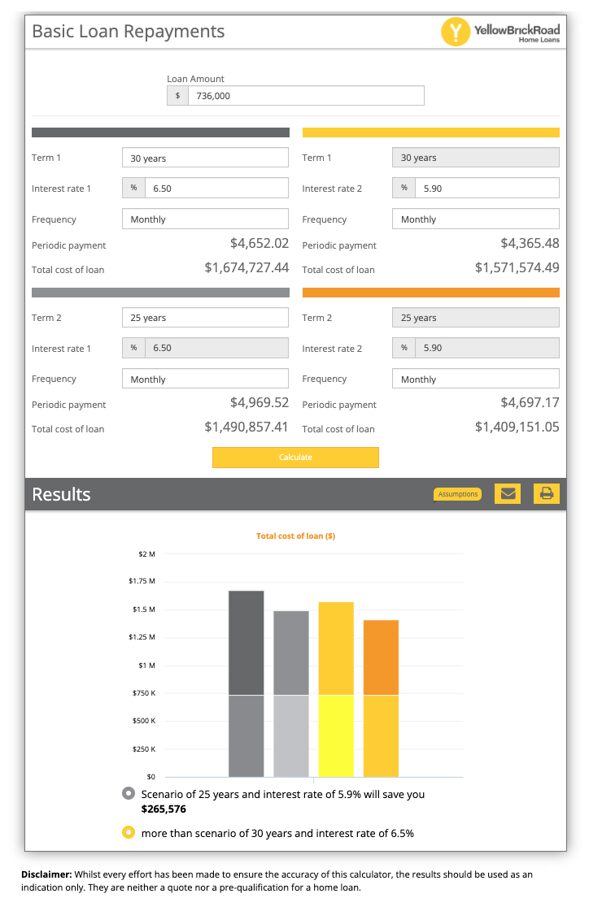
Say your loan size is $736,000. If your current interest rate is 6.5%, your monthly repayments will be $4,652.
If you discover that competitive rates are sitting around 5.9 percent, the difference of 0.6 percent might sound small. But your monthly repayments would be $4,365.42.
That’s a monthly saving of $286.58.
However, applying that lower rate to your $736,000 balance could reduce your repayments by hundreds of dollars every month. Over a couple of years, that adds up to thousands of dollars staying in your bank account instead of going to your lender.
Individual savings will vary. Speak to a YBR mortgage broker for a personalised assessment.
STEP 4: Decide on your action plan
You now know your rate, you know what the market is offering and you know how much money is at stake. The only thing left to do is decide how you want to handle it.
You have two main options. You can call your current bank and ask them to match the new customer rate. Sometimes they will reduce your rate simply because you asked. However, they might not offer you the absolute best deal available in the broader market.
Your other option is to speak with an expert who can look at the entire market for you. A mortgage broker understands the policies, the hidden fees and the true cost of switching loans. They do the heavy lifting to ensure you are matched with a solution tailored to your specific needs.
If you spent 10 minutes today and realised you are paying more than you should be, we are here to help you fix it. Reach out and speak with a local Yellow Brick Road mortgage broker to see if there are better options out there suited to you and your circumstances.
