
 1800 927 927
 Contact Us
 Find a Broker
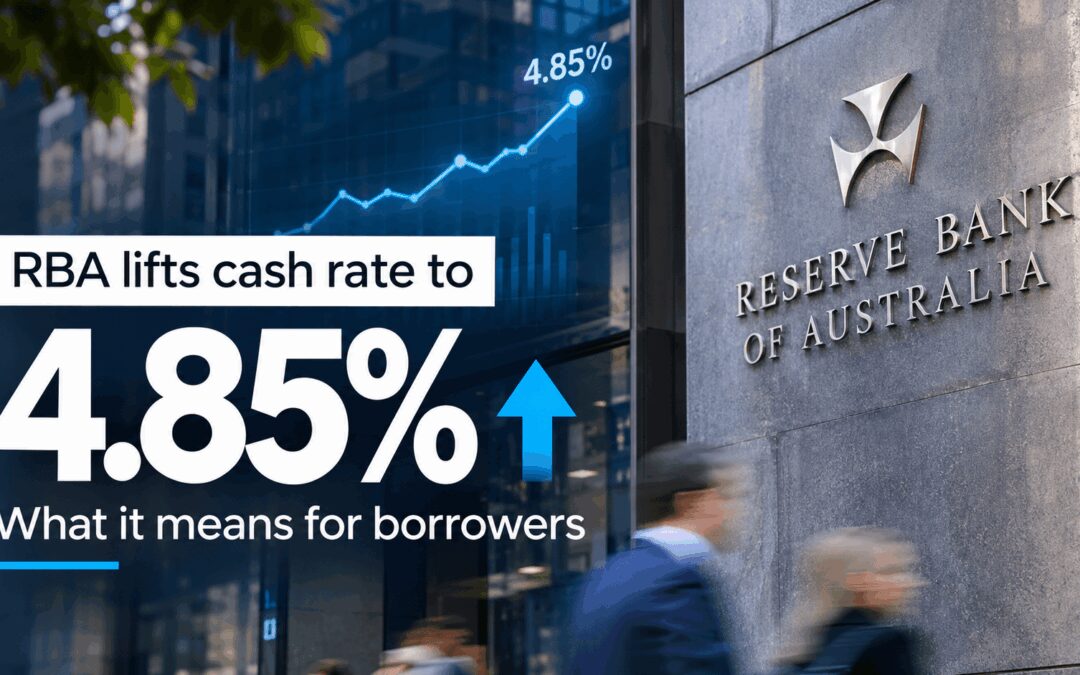
The Reserve Bank of Australia has lifted the cash rate to 4.85% at today’s meeting, a fifth increase this year and the highest the cash rate has been since 2008.
It’s the outcome financial markets had been leaning towards since yesterday’s hotter than expected inflation data, though the major banks were split heading into today’s 2:30pm announcement. Westpac and ANZ had forecast another rise; Commonwealth Bank and NAB had expected the Board to hold.
“There is no indication from the Reserve Bank’s statement today that this could be the last of the interest rate rises. If the data isn’t any good coming out of December, which we’ll see at the end of January, the betting right now would be on another rise at the February meeting. That would be six rate rises. I don’t know how that’s sustainable for Australia.” – Mark Bouris, reacting to today’s decision
Why the RBA hiked
Inflation proved the deciding factor. The Australian Bureau of Statistics’ September quarter Consumer Price Index, released yesterday, showed headline inflation at 4.3% over the year, up from 4.0% in August, while the trimmed mean, the RBA’s preferred underlying measure, rose to 3.7% annually. Both came in hotter than economists had forecast, and both remain well above the RBA’s 2 to 3% target band.
Speaking ahead of the release, Governor Michele Bullock had flagged that inflation was likely to run above the Board’s August forecasts, pointing to higher energy prices flowing from the Middle East conflict and a labour market that remains tighter than the headline unemployment rate alone suggests.
The jobs market gave the Board more reason for caution than it had in September. Unemployment has climbed to 4.7%, a five year high and up 0.6 of a percentage point since January, and NAB’s announcement in October that it would cut up to 2,500 roles added to a sense that the labour market is turning. In the end, the Board gave more weight to yesterday’s inflation surprise than to that run of softer jobs and confidence data, a different call to the one some economists had leaned towards just days earlier.
The RBA’s statement
In its post-meeting statement, the Board explained its reasoning for today’s move.
“The Board is conscious of the period in which inflation has been too high. Given the revised inflation outlook and the continuing upside risks, the Board judged that a further tightening in financial conditions is warranted to support the return of inflation to target.
The Board will continue to do what it considers necessary to bring inflation sustainably back to target. Accordingly, the Board will be attentive to the data and the evolving assessment of the outlook and risks to guide its decisions.”
Source: Reserve Bank of Australia, Statement by the Monetary Policy Board: Monetary Policy Decision, 3 November 2026.
Today’s decision was not unanimous. Six members of the Board voted to raise the cash rate target by 0.25 percentage points to 4.85%, while three voted to leave it on hold at 4.60%.
What this means for your repayments
If you’re on a variable rate, today’s rise means another increase to your minimum monthly repayment, the fifth this year. Canstar’s modelling shows what a single 0.25 percentage point rise adds across different loan sizes:
| Loan size | Estimated monthly change | Estimated annual change |
| $600,000 | +$96 / month | +$1,147 / year |
| $800,000 | +$127 / month | +$1,529 / year |
| $1,000,000 | +$159 / month | +$1,911 / year |
Source: Canstar, A fourth rate hike in 2026: What you need to know, October 2026. November repayment estimates based on an owner-occupier paying principal and interest with 25 years remaining in February 2026, at the RBA average variable rate. Assumes the November 0.25 percentage point increase is passed on in full by lenders the following month. Figures represent changes to minimum monthly repayments. General information only.
That takes the total increase from this year’s five hikes to $455 a month on a $600,000 loan, or $5,460 a year, and to $760 a month, or $9,120 a year, on a $1 million loan.
What the housing market looked like going into today
Cotality’s October 2026 Monthly Housing Chart Pack shows a market that has lost real momentum since the start of the year. National dwelling values were flat over the year to September, up 0.0%, and down 3.7% over the September quarter alone, even though values are still flat over the past year rather than falling.
Sydney (down 4.9% for the quarter, down 7.0% annually, and now 8.6% below its February 2026 peak) and Melbourne (down 3.4% for the quarter, down 6.2% annually, 7.5% below its March 2022 peak) remain the weakest capitals. Brisbane, Perth, Adelaide, Hobart and Darwin are all still up over the past year, between 5.9% and 11.9%, but every capital fell over the September quarter, Darwin included, with a smaller rise.
Buyer demand has cooled alongside values. The combined capitals clearance rate was 45.4% last week, down from 64.4% in late February, and homes are taking much longer to sell, with the national median time on market stretching to 41 days over the three months to September, up from 26 days a year earlier. Vendors are discounting harder too, with the median discount widening to 4.2% nationally, up from 3.2% a year ago, while total advertised stock is running 19.1% above where it was this time last year.
What comes next
Westpac and ANZ, who correctly forecast today’s move, now see the cash rate at or near its peak for this cycle, with the next move more likely to be a cut, though not before well into 2027. CBA and NAB, who had expected a hold, are likely to review their own outlook in the coming days.
For now, borrowers should plan around today’s higher rate holding for an extended period rather than assume relief is close.
What borrowers should do now
Know your current rate. Many borrowers know their repayment amount but not the actual interest rate they’re paying, and that’s the starting point for any comparison.
Check when you last reviewed your loan. If it has been more than 12 months, the market has likely moved around you, whatever the RBA does today.
Understand your options before you need them. Whether you want to reduce repayments, consolidate debt, access equity or pay your loan down sooner, it helps to know what’s available.
Taking a few minutes to understand where your loan stands today could make a meaningful difference over the life of your mortgage.
If you’d like to see whether your current loan is still competitive, speak to a YBR broker or explore your refinancing options at ybr.com.au/refinance-home-loan.

Recent Comments