
 1800 927 927
 Contact Us
 Find a Broker
In this article:
You have probably seen the headlines. “Prices tumbling.” “Auctions failing.” “The market is in freefall.” Then you talk to a mate in Perth or Brisbane and their place is still climbing. So which is it?
According to Tim Graham, Managing Director of Hotspotting, the answer is both. And if you are thinking about buying, selling or holding right now, the difference between those two realities is where your next decision needs to start.
Tim joined Mark Bouris on the latest episode of Property Insights to unpack what is actually happening across the country, why the market has fractured, and where the growth is quietly still running.
Quick take
- The Australian property market is not falling as one. It is fragmenting, with some markets cooling hard while others keep growing.
- Higher-end Sydney (above $2 million), the Northern Beaches and the Mornington Peninsula are among the softest.
- Western Sydney, Wollongong, Newcastle, Frankston, the Sunshine Coast and parts of Brisbane, Adelaide and Perth are still holding up or growing.
- Units are outperforming houses across every capital city and regional market in the country, according to Hotspotting’s data.
- Recent federal budget changes to capital gains treatment are already showing up in listings, sentiment and first home buyer activity.
The market is not one market
The line Tim keeps coming back to is fragmentation. At the start of 2026, every single jurisdiction in Australia, 8 capital cities and 7 regional markets, was in positive territory. His business partner Terry Ryder, who has been analysing property for 40 years, said he had not seen that in at least 30 years.
That has now started to rotate. Some markets are cooling. Others are still climbing. Same Prime Minister, same cash rate, very different outcomes.
Tim’s example makes the point. At the end of 2024, Perth was running at 18% growth while Melbourne was sitting at -3%. A 21% spread across the country in the same year. If you bought in the wrong market at the wrong time, that gap is your problem, not a statistic.
Hotspotting tracks 17,000 individual markets around Australia (most suburbs have both a house and a unit market) and scores each one on what it calls the Hotspotting Thermometer. The score is built from forward-looking indicators like sales volumes, days on market and the percentage of properties selling above asking price.
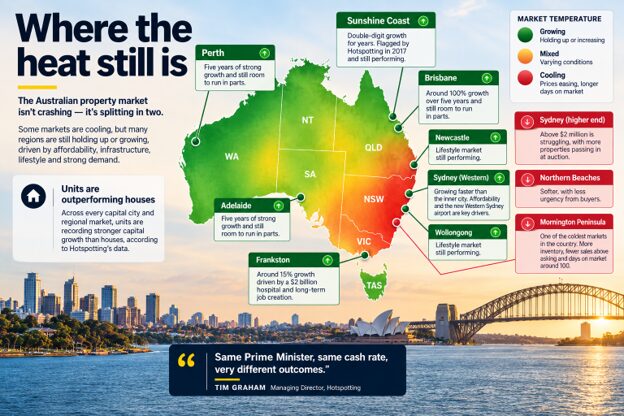
Where the heat still is
A few areas Tim called out on the episode:
Western Sydney. Growing faster than the inner city right now. Affordability is doing the heavy lifting, and the new Western Sydney airport is drawing investment into the corridor around it.
Wollongong and Newcastle. Lifestyle markets that are still performing while parts of Sydney’s higher end have stalled.
Frankston (Melbourne). Running at around 15% growth while the broader Melbourne market sits at -3%. Tim puts a lot of that down to a $2 billion hospital going in, which brings construction jobs in the short term and higher-paid, long-term jobs after that.
Sunshine Coast (Queensland). Hotspotting flagged it back in 2017 and it has delivered double-digit growth for years. Tim bought there personally last year.
Brisbane, Adelaide and Perth. Five years of strong growth (Brisbane close to 100% over five years, according to Tim) and, in his view, still room to run in parts.
And where it has gone cold
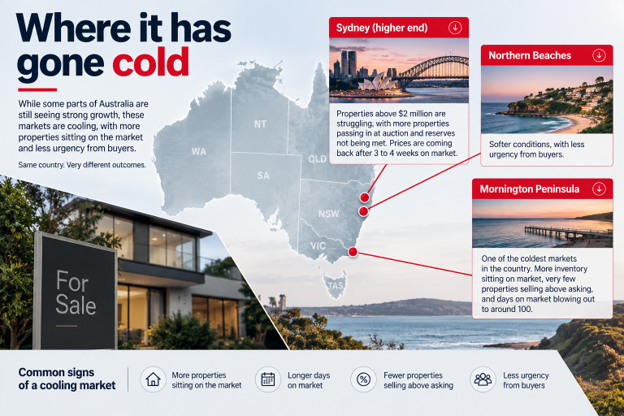
Sydney above $2 million. The market Mark and Tim both flagged as struggling. Properties passing in at auction, reserves not met, prices coming back after 3 to 4 weeks on market.
Northern Beaches and parts of Sydney’s inner city. Softer, with less urgency from buyers.
Mornington Peninsula. One of the coldest markets in the country on Hotspotting’s thermometer. More inventory sitting on market, very few properties selling above asking, days on market blowing out to around 100.
If you are selling into one of those cooler markets, Tim’s advice is blunt. Get your skates on. A house that fetches $X today can be worth meaningfully less in three months if the trend keeps running against you.
Units are quietly outperforming houses
This one surprises most people. The old rule was to buy the biggest block of land you could afford. Right now, according to Hotspotting, units are outperforming houses on capital growth across every Greater Capital City Statistical Area, both city and regional.
Why? Affordability, higher rental yields, and a shift in how Australians want to live. Downsizers, lock-up-and-leave lifestyles, and people wanting to be closer to amenity rather than 50 minutes out.
Tim’s warning: he is not talking about large high-rise complexes. He is talking about lower-density stock. Duplexes. Old blocks of 6, 8 or 10. Solid brick. Some character. The kind of building where the body corporate is not going to eat your net yield alive.
A stat worth sitting with: the best performing capital growth market in the country last year was Harristown in Toowoomba, with 60% price growth in the unit market in 12 months, according to Hotspotting.
The federal budget changed the mood
You cannot talk about the current market without talking about the recent budget changes to capital gains treatment on investment property.
Tim’s view, and he was clear this is his: for anyone who already owns an investment property under the old rules, there is now less reason than ever to sell. Stamp duty, agent fees and re-entry costs already make transacting expensive. Add a changed capital gains landscape and the maths tilts hard toward holding.
We are seeing the same thing at the coalface. First home buyer activity has come off. Rentvestor strategies that made sense a year ago do not work the same way now. Listings have ticked up, which usually signals owners feeling pressure rather than confidence.
NAB has forecast Melbourne and Sydney rents could rise by around 30%, which sits well above the Treasury modelling around the recent changes. Nobody knows exactly how that plays out, but a national vacancy rate under 2% (a balanced market is considered 3%) does not suggest rents are heading down any time soon.
What this means for you
A few practical takeaways if you are trying to make a decision right now.
If you are buying, cheap is not the same as good. A property that has dropped $200,000 is only a bargain if the trend underneath it is turning back up. Days on market, sales volumes and the percentage of properties selling above asking are the signals worth watching, not the headline discount.
If you are selling in a cooling market, price to the trend, not to what your neighbour got last year. Waiting three months to “see what happens” is a strategy that has cost sellers real money in 2026.
If you are holding, the case for staying put has probably strengthened. Rents are tight, transaction costs are high, and the tax landscape has shifted. Refinancing to a sharper rate is often the more useful lever than selling.
If you are a first home buyer, do not let the noise freeze you. Fragmentation cuts both ways. There are markets where affordability has improved and fundamentals are still solid. That is exactly the kind of research a good broker and a good buyer’s agent should be doing with you.
Where a broker fits in
The reason we love this episode is that it puts a number on something we have been saying to clients all year. The “Australian property market” is not one thing. Your suburb, your price point, your loan structure and your timeline all matter more than the national headline.
A local YBR broker can pull the pieces together. What you can borrow now, what your repayments look like at current rates, how a refinance changes your position, and whether the property you are looking at stacks up against your actual goals. If you want to run the numbers on repayments or borrowing power before you talk to anyone, our [home loan calculators](https://ybr.com.au/calculators/) are a solid starting point.
Watch the full episode of Property Insights with Mark Bouris and Tim Graham on the Yellow Brick Road YouTube channel HERE.
This is usually the point where a quick conversation with a local broker can stop a small decision becoming an expensive one. Find your nearest Yellow Brick Road broker at https://ybr.com.au.
The information in this article is general in nature and does not take into account your personal circumstances, financial situation or objectives. Views expressed by guests on Property Insights are their own. Before acting on any information, consider its appropriateness for your circumstances and seek independent professional advice.
